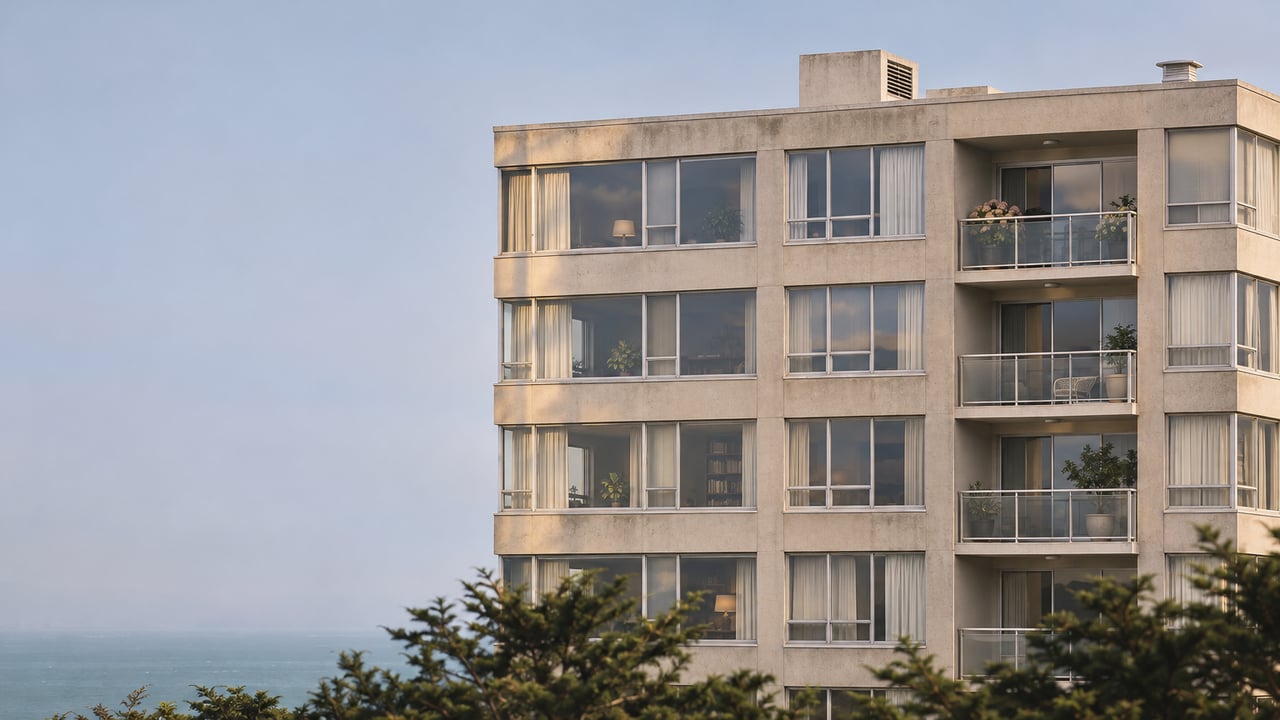
Russian Hill's Older High-Rises Carry a Sprinkler Bill No Listing Price Shows
November 12, 2026
November 12, 2026
At the October 16 meeting of San Francisco's Fire Code Technical Advisory Council, council member Miller spoke about the condo and co-op owners she represents. Supervisor Stephen Sherrill asked whether special assessments had pushed people to sell. She said that hadn't happened in her building. Then she added that several sales there had fallen through because of the burden of the sprinkler retrofit, according to the council's posted minutes.
The retrofit's completion deadline is a little more than eight years away, and it is already reshaping deals. For anyone pricing a two-bedroom in a covered tower, that is the number missing from the listing. A city-ordered capital project with no settled cost and no public funding sits behind many of the hill's best views. That obligation reaches a buyer through HOA records and the lender's review of the building.
San Francisco passed a law in 2022 removing a long-standing exemption that had let residential high-rises skip automatic sprinklers. The original deadline was 2028. In March 2026, the Board of Supervisors gave owners more time. The Board's Budget and Legislative Analyst laid out the new schedule in an August 3, 2026 report.
| Date | What happens |
|---|---|
| January 1, 2032 | Sprinkler permit applications due at the Department of Building Inspection |
| January 1, 2034 | Water supply and riser installation due |
| January 1, 2035 | Full sprinkler system complete |
| July 2028 | When a city official at the October 16 council meeting said a subsidized loan or grant program could potentially be approved through the budget process |
The rule targets buildings that predate California's 1974 sprinkler requirement for new high-rises. The Fire Department estimates about 129 buildings citywide could be covered. Roughly 40 percent appear to be condominiums, and the buildings are "concentrated primarily in the City's northeastern neighborhoods." In its coverage of the council's first meeting, the San Francisco Chronicle put the count at 126 pre-1970 high-rises from North Beach to Nob Hill and roughly 9,000 units.
Russian Hill has a number of towers on the city's preliminary list. They went up in the decades when the hill was building upward, which is also why they own the views. In January 2026, the San Francisco Public Utilities Commission answered an inquiry from Supervisors Sherrill and Danny Sauter. Its response letter includes a preliminary screening of the buildings identified, and that list names these addresses on and around the hill:
The screening is preliminary. SFPUC says it reviewed only the size and layout of the water mains next to each building. It did not make final calls on which buildings need infrastructure upgrades. Still, the list shows where the issue lives. These are some of the hill's most recognizable residential towers, and they span the whole condo market. In the combined Russian Hill, North Beach and Nob Hill condo data for 2026 through September 18, the year's highest sale was 1101 Green #1801, which sold for $7,350,000 for 4,105 square feet after 99 days on the market. The lowest was a 411-square-foot studio at 1177 California for $325,000. Both addresses appear on the SFPUC list.
Across those three neighborhoods, the 123 condo sales through September 18 had a median of $1,425,000, or $1,249 per square foot, with 14 median days on market. In the third quarter through September 18, median days on market rose to 20. The median mixes towers with low-rise buildings. Two units with similar square footage, views and finishes can carry very different future obligations, and the median prices them as if they were the same.
The analyst's report declined to estimate cost building by building. It modeled a hypothetical 50-unit tower and got a range of $15,000 to $224,900 per unit. The range is wide because each variable is building-specific:
Supervisor Sherrill said at the October 2 council meeting that, given all the variables, it would be "nearly impossible to determine a cost for each building." Owners have pushed back on whether the work is needed at all. Mark Kane, a retired San Francisco firefighter who lives in Fontana Towers in the Marina, told the council his building is "a concrete fire-proof box," the Chronicle reported. On Russian Hill, Daniel Rabinowitz, a resident and building treasurer at 1070 Green Street, presented his analysis of 27 years of Fire Department data. He reported no fire deaths in the 126 covered buildings over that period.
The financing gap is the real friction, and for co-op buyers it is wider. At the October 16 meeting, a city official said San Francisco has no budgeted funds for retrofits of privately owned buildings and does not lend money itself. One idea floated was a Request for Information to find banks willing to lend to associations. A subsidized loan or grant program would then have to go through the budget process, and he said it could potentially be approved by July 2028. Supervisor Sherrill noted that this second option could be difficult given the city's projected deficit.
Until then, the money comes from owners. Miller told the council the retrofit would be a special assessment that every homeowner pays. She said few banks lend to co-ops, the big national banks don't make these loans, and the offers she had seen were 15-year loans at 6 to 7 percent from the two institutions in the field. She estimated that 40 to 45 of the covered buildings are co-ops. Most of San Francisco's co-op buildings are on Russian Hill and Nob Hill, so that estimate matters more on these two hills than in most neighborhoods.
The analyst's report makes the same structural point. Condo owners depend on collective decisions and shared financing run through the association, which in practice means special assessments or HOA loans.
A pending capital project like this can show up in documents a buyer receives or can request, and in the questions a lender asks.
On the lending side, the Fannie Mae and Freddie Mac project questionnaire addendum asks the association:
"Is it anticipated the project will, in the future, have such violation(s)? If Yes, provide details of the applicable jurisdiction's requirement and the project's plan to remediate the violation."
This is general information, not legal, tax or financial advice. Confirm how these rules apply to a specific unit with a real estate attorney and your lender.
The council can only advise. Its bylaws give it no power to overturn the ordinance. Its recommendations go to the Mayor, the Board of Supervisors, the Fire Department and the Fire Commission. Much of its work so far has gone into defining five terms in the code that could open a path to alternative compliance or waivers: "reasonable degree of fire protection," "alternative protection," "not physically possible," "disproportionate effort" and "undue hardship." The analyst's report lists repeal, an NFPA-based alternative safety standard, building-by-building cost profiles and city loans as options, without ranking them.
The council holds a special meeting tomorrow, Friday, November 20, from 10 a.m. to noon. Under the current law, the 2032 permit deadline still applies.
Is there a known cost for my building? Not from the city. The analyst's report models a hypothetical 50-unit building, and SFPUC says it can't assess infrastructure needs until it receives project-specific applications.
If you own in one of the towers on that list and want to understand how a future assessment could affect your sale price, or you're buying and want help reading a building's minutes before you write an offer, Minna Real Estate can walk through the numbers with you.
Stay up to date on the latest real estate trends.

Minna Millare combines San Francisco‑native insight with investment‑savvy strategies, remodeling expertise, and a client-centered approach. Let her guide you step-by-step through California’s dynamic market, ensuring smart decisions and personalized results.